News
1st Workshop on VReID-XFD: Video-based Human Recognition at Extreme Far Distances
6 March 2026 Tucson, Arizona, USA WACV 2026
We organized the 1st Workshop on Video-based Human Recognition at Extreme Far Distances (VReID-XFD) based on the DetReIDX dataset at WACV 2026, Tucson, Arizona.
The workshop brought together researchers advancing UAV-based person re-identification, long-range video analytics, and extreme-distance recognition. We thank all authors, reviewers, and competition participants for their contributions, with special thanks to Prof. Hugo Proença for leading the DetReIDX challenge.
Workshop papers: https://lnkd.in/eb-mKKiB
Paper accepted at IEEE Transactions on Biometrics, Behavior, and Identity Science
Hambarde et al., "DetReIDX: A Stress-Test Dataset for Real-World UAV-Based Person Recognition", 2026.
IEEE T-BIOM 2026
Abstract
We introduce DetReIDX, a new large-scale benchmark dataset designed for real-world, long-range human recognition. It supports four core computer vision tasks: person detection, re-identification (ReID), multi-view tracking, and action recognition — all captured in complex outdoor scenes using UAV drones and ground cameras across seven international collection sites.
DetReIDX contains 509 unique identities with over 13 million bounding box annotations, captured from 18 UAV viewpoints per subject at altitudes ranging from 5m to 120m and distances of 10–120m. Each subject wears different outfits across sessions to evaluate long-term clothing-change robustness. Every frame is labeled with 16 soft biometric attributes (age, gender, clothing, action, etc.), providing fine-grained annotations for comprehensive evaluation of human-centric AI under real-world aerial surveillance conditions.
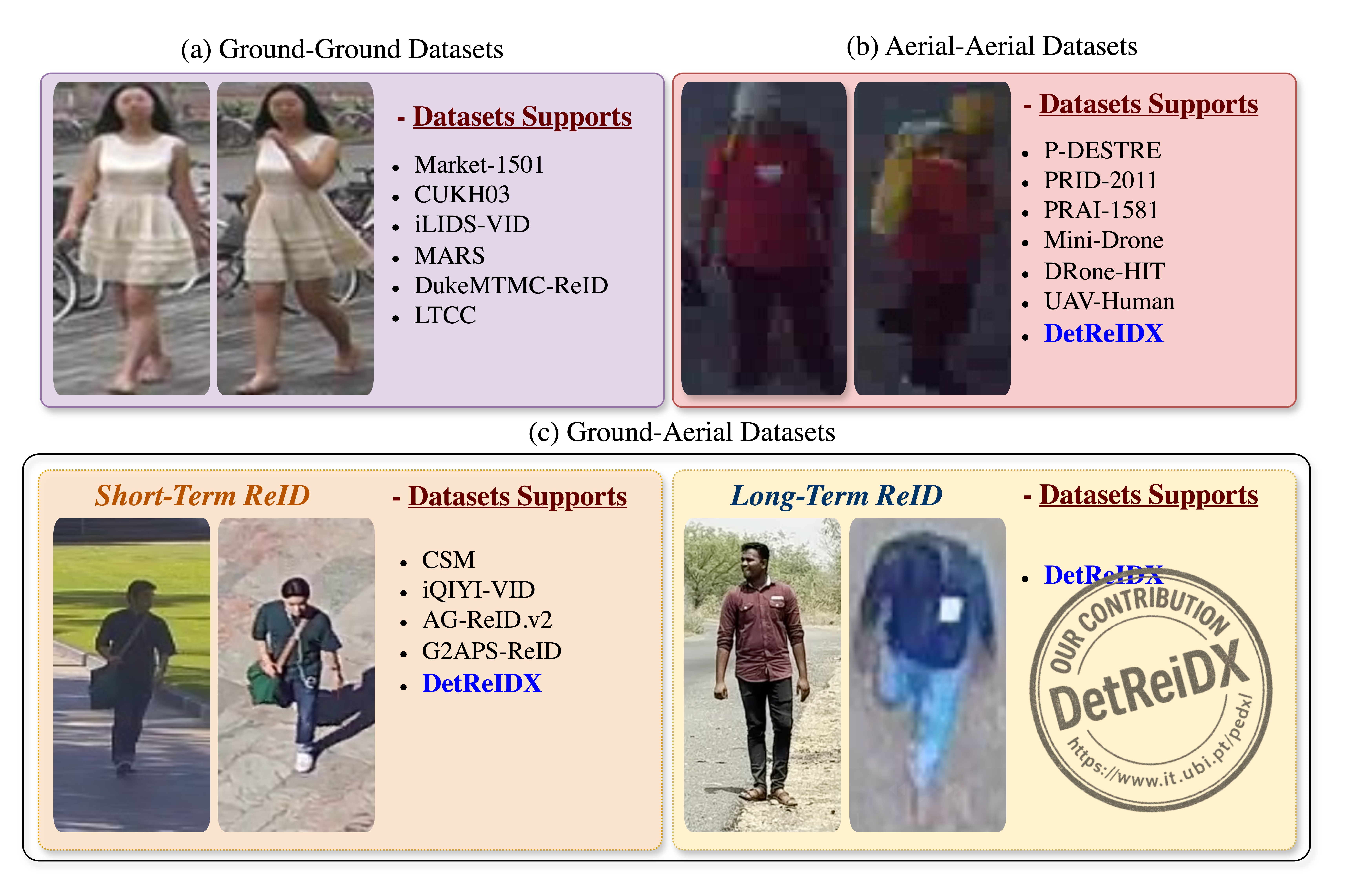
Figure 1: Comparison between existing datasets (ground-ground, aerial-aerial, and aerial-ground) and DetReIDX. Unlike counterparts, DetReIDX includes clothing variation, detection and tracking annotations, action labels, and wide aerial altitude coverage (5.8m–120m), making it well-suited for long-range surveillance tasks.
Dataset Examples
Sample recordings from each participating institution.
Outdoor UAV Examples
Indoor Reference Session
Indoor profile and gait capture session: front, left, and right angles per subject.
Dataset
Comparison with Existing Datasets
DetReIDX exceeds prior datasets in altitude span, viewpoint coverage, identity diversity, and annotation richness. DetReIDX (row 19, highlighted) is the only dataset combining aerial altitudes up to 120m, cross-session clothing variation, and all five task annotations.
| No. | Dataset | Camera | View | Format | Det. | Track. | ReID | Search | Action | PIDs | BBox | Height (m) | Distance (m) |
|---|---|---|---|---|---|---|---|---|---|---|---|---|---|
| 17 | AG-ReID.v2 [17] | UAV + CCTV | Ground + Aerial | Still | ✓ | ✓ | ✓ | ✓ | ✗ | 1615 | 100.6K | 15~45 | - |
| 18 | G2APS-ReID [18] | UAV + CCTV | Ground + Aerial | Still | ✓ | ✓ | ✓ | ✓ | ✗ | 2788 | 200.8K | 20~60 | - |
| 19 | DetReIDX (Ours) | DSLR + UAV | Ground + Aerial | Video + Still | ✓ | ✓ | ✓ | ✓ | ✓ | 334 | 13M | 5~120 | 10~120 |
Research Challenges
DetReIDX exposes critical challenges in person recognition that are overlooked in traditional datasets but common in real-world UAV surveillance:
Extreme Scale Variation
Person ROIs range from full-HD indoor captures to sub-10px silhouettes at 120m altitude, testing resolution robustness.
Clothing Variation
Subjects wear different outfits across sessions, requiring models to learn identity beyond superficial appearance cues.
Viewpoint Diversity
18 unique UAV perspectives across three pitch angles (30°, 60°, 90°) challenge current view-specific approaches.
Cross-Domain Transfer
Aerial-to-ground matching requires bridging vastly different capture modalities and perspectives.
Occlusion & Blur
Real-world interference from motion blur, atmospheric conditions, and partial visibility.
Temporal Drift
Multi-day sessions with environmental changes test long-term recognition capabilities.
Data Collection Protocol
Data was collected using high-resolution drones (DJI Phantom 4) and DSLR cameras through a multi-institutional collaboration across Portugal, Angola, Turkey, and India, under diverse altitudes (5–120m), distances (10–120m), and pitch angles (30°, 60°, 90°).
| Setting | Environment | Altitude | Distance | Data Type |
|---|---|---|---|---|
| Indoor | University Labs | Ground level | Close range | Profile images, gait videos |
| Outdoor | University Campuses | 5–120m | 10–120m | Multi-view videos, action clips |
Annotation Protocol
The dataset includes over 13 million manually annotated bounding boxes for 509 unique identities, created with CVAT and verified by multiple annotators. Each subject is annotated with 16 soft biometric attributes covering demographics, appearance, and activity.
Full experimental results (YOLOv8, DDOD, Grid-RCNN, PersonViT, SeCap, CLIP-ReID) are available in the paper.
Dataset Access
DetReIDX is available for academic and non-commercial research use.
Person Detection
Bounding box annotations for UAV & ground views
Video ReID
Multi-session tracklet sequences across altitudes
n1947@ubi.pt or kailas.srt@gmail.com
Subject: "DetReIDX Password Request"
Citation
Acknowledgements
We acknowledge and give credit to the following universities for their contributions: Istanbul Medipol University, J.N.N College of Engineering, SRM Institute of Science and Technology, Swami Ramanand Teerth Marathwada University Nanded, Universidade Beira Interior, Universidade de Luanda. (Sorted in A–Z order)

BibTeX
@article{hambarde2026detreidx,
  title={Detreidx: A stress-test dataset for real-world uav-based person recognition},
  author={Hambarde, Kailash A and Mbongo, Nzakiese and Kumar, MP Pavan and Mekewad, Satish and Fernandes, Carolina and Silahtaro{\u{g}}lu, G{\"o}khan and Nithya, Alice and Wasnik, Pawan and Rashidunnabi, MD and Samale, Pranita and others},
  journal={IEEE Transactions on Biometrics, Behavior, and Identity Science},
  year={2026},
  publisher={IEEE}
}